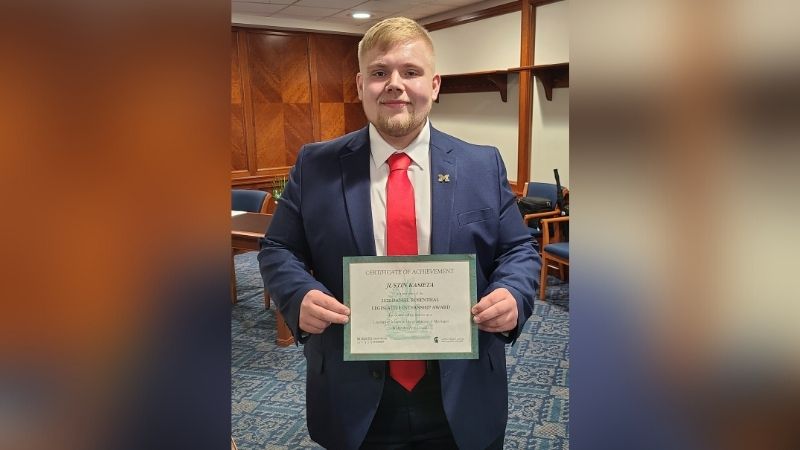
Justin's Story
I was 13 when I lost my father. Then the state took what he left behind.
When Justin Kasieta was thirteen, his father died of cancer. His mother, struggling with addiction, could no longer care for Justin and his four siblings. They were placed in foster care — and that's when the state of Michigan quietly applied to become the representative payee for their Social Security survivor benefits.
No one told Justin. No one asked permission. Over three years, more than $18,000 in benefits — money his father had earned through a lifetime of work — was silently intercepted by the state to reimburse itself for the cost of Justin's care.
"That $18,000 could have paid for tutoring, college books, a first car, stable housing — a chance at a future. Instead, it disappeared without a word."
Now a University of Michigan graduate and advocate, Justin testified before the Michigan Senate Committee in February 2025, urging passage of legislation to end this practice in his home state.
Understanding the Issue
What Is the Orphan Tax?
It's simpler — and worse — than you think.
Here's the deal. When a parent works, they pay into Social Security. If that parent dies, their children receive monthly checks called survivor benefits. It's not welfare. It's not charity. It's money their parent earned. Think of it like an inheritance — the government sends it to help the kids get by.
Now imagine you're a kid whose parent just died. You end up in foster care because there's no one else to take care of you. You'd think those survivor checks would be saved up for you — maybe for college, or a car, or an apartment when you turn 18. Instead, the state quietly takes that money and uses it to pay itself back for the cost of your foster care.
Nobody tells you. Nobody asks your permission. You're a child. You don't even know the money exists. And by the time you age out of foster care at 18 — often with nothing but a trash bag of belongings — thousands of dollars that were meant for you have already disappeared.
The worst part? The state is already required by law to pay for foster care. They're supposed to cover that cost anyway. Taking a foster kid's survivor benefits is like charging a patient for their own ambulance ride — after the hospital already agreed to cover it. That's why people call it the orphan tax.
What one year of average benefits (~$10,970) could provide for a foster youth aging out of care
Common Questions
What People Ask Us
As Seen on CBS Sunday Morning
Watch: The Fight to End the Orphan Tax
Source: CBS Sunday Morning, April 7, 2024 · 10:31
The Scale
The Numbers Behind the Orphan Tax